This project came to me from a conversation I had with my girlfriend. I expressed feeling a bit inadequate because I didn’t quite
understand the references a film (All About My Mother) was making to another film/play (A Streetcar Named Desire).
She jokingly asked if I paused my movie to go watched the one it was referencing... And this spawned me to think about the
birth of this project: Wouldn’t it be fun to watch a movie from every year that there has been one?
Within minutes there I was, plotting this little project. I opened up a document and started plotting my mov[i]es.
1874: Passage de Vénus
Let’s be real: The birth of film is cool as fuck. This is considered the oldest film, documenting the transit of Venus, which is when
Venus crosses between the sun and the Earth. This alone is incredibly cool and a phenomenon that doesn’t ever occur once in a lifetime,
but when it does, it’s a paired event. This film documents the first passage of Venus on December 9th, 1874 (the other in the pair would
occur in 1892. The next after that were in 2004 and 2012 respectively.)
The film was done on a Janssen revolver, created specifically to document this event. A Janssen revolver pretty much takes a series of
stills in succession on a daguerreotype disc (Which apparently was no longer used by this point, but used in this instance due to the
conditions of the sunlight in tandem with the exposure of the discs). The duration between each still was 1.5 seconds. There were 48
photographs taken in 72 seconds.
The film itself was taken in Nagasaki Japan, in collaboration with the French embassy there. The creator of the device, an
astronomer named Pierre Jules César Janssen, worked alongside Brazilian engineer and astronomer Francisco Antônio de Almeida.
The phenomenon was captured from Mount Konpira.
The film itself is incredibly grainy, but you can definitely make out what’s happening, especially if you have the surrounding
knowledge of what you’re looking at. It’s a cool piece of history and worth the 6 seconds it takes to watch.
1878: The Horse in Motion
The Horse In Motion is often considered the first piece of cinematic history. It’s a 12-frame piece documenting a horse’s gait.
Honestly, again, just for the historical factor, it’s cool as fuck.
The main players in the story behind this are as follows: Former Californian governor and many other things, but important for this story:
racehorse breeder Leland Stanford; Photographer, Eadweard Muybridge, who he is his own rabbit hole involving a “justifiable homicide” murder;
And lastly, the horses involves, Sallie Gardner. The premise for this whole thing to transpire was in relation to how horses were
portrayed galloping in the arts previously to this, in sort of a “flying” stance. Unable to find a good reference for this, Stanford
set out for this to be documented.
The film, photographed on June 19th, 1878, in Palo Alto on a track owned by Leland Stanford. The film shows Sallie Gardner running with a
backdrop of a numbered grid. The photographs were taken by Sallie Gardner tripping wires as she ran, releasing the shutter on 12 cameras
in total. She speed was about 40mph.
This series of images subsequently made the idea of a “flying gallop” go out of style when depicting horses.
1887: Man Walking Around A Corner
Louis Le Prince, the man behind this picture, is a name that’ll come up again. He was the inventor of an early film camera and also declared
as a missing person three years after this film and declared dead only 10 years after this film.
The film is yet again very short, spanning 2 seconds and consisting of 16 frames. The man in the video is unknown, and despite the name,
he doesn’t even really round out the corner (false advertising, this early...!). As mentioned, Louis Le Prince made the camera himself,
a contraption that had 16 lenses on it. The design of the camera makes each picture taken have a slight shift to it, but it’s not really a
bother unless you’re looking for it. The exposure of some of the lenses were slightly off, which was later fixed by Louis Le Prince.
The film was shot at the corner of Rue Bochart-de-Saron in Paris.
1888: Roundhay Garden Scene
This was another film by Louis Le Prince, and perhaps his more famous one. Unlike his previous film, this one was shot in Roundhay, Leeds, England.
The specific place was Louis Le Prince’s in-laws (Joseph and Sarah Whitley) garden, and it features both of them alongside family friend
Annie Hartly. This was filmed 10 days before the death of Sarah, who died at 72.
This film is an interesting case of not just everyone involved being no longer alive, but even the place this was shot at is not longer there.
The house was demolished in 1972 and replaced with modern housing. The adjacent home is still there however, which is now used as a nursing home.
The film itself is only 2 seconds and 20 frames, shot at approximately 7FPS, just like Louis Le Prince’s former film. The film was originally
printed in reverse, but it was fixed when it was processed into video.
1889: Monkeyshines
Originally, I had another film planned for this entry. However, that film was mostly lost, so I went with this one, the only other film in this
year according to Wikipedia.
Monkeyshines are technically 3 films, with only 2 being available to view because the third is lost to time. All it shows is very, VERY
blurry lab workers at Edison labs doing weird motions. I have to say... This isn’t the most impressive even by the day’s standards,
I’m sorry. Seeing it after the other films was kind of a let down. I do think this was underwhelming after the clearer pictures seen
in Louis Le Prince’s work (no wonder there’s a theory Edison had him whacked).
Granted, this was done in a whole other method, and I think the technological aspect of that is interesting– it was supposedly done to
test the original cylinder format of the Kinetoscope. It’s also worth mentioning that these pieces of film are a LOT longer than previously seen;
Together, Monkeyshines 1 and 2 are 56 seconds.
I am disappointed this had nothing to do with monkeys. I do think this would be killer for a music video of some weird noise band though.
1889 BONUS: Leisurely Pedestrians, Open Topped Buses and Hansom Cabs with Trotting Horses
This was originally the film that was going to be the entry for 1889. However, only 6 frames remain of this film, so I felt I had to choose another.
The film is also known as Hyde Park Corner and was made by William Friese-Greene.
The film, interestingly enough, was not even received well by people at the time. To quote Wikipedia which can elaborate better than I can on
this matter:
Since flickering imagery can only be perceived by the human brain as one fluid moving frame from about 16 frames per second, the low 10
frames per second of the chronophotographic camera were deemed to be the cause of the underwhelming audience reaction.
Even beyond that, there seems to have been some drama on when this film was even made. William Friese-Green reported he took the film in January
of 1889, whereas the Science Museums Group states it was October of 1889. Historians also debate whether the film was actually from this time
period as well.
While a lot of this film remains murky, it is considered the first film shot in London and the first shot on celluloid.
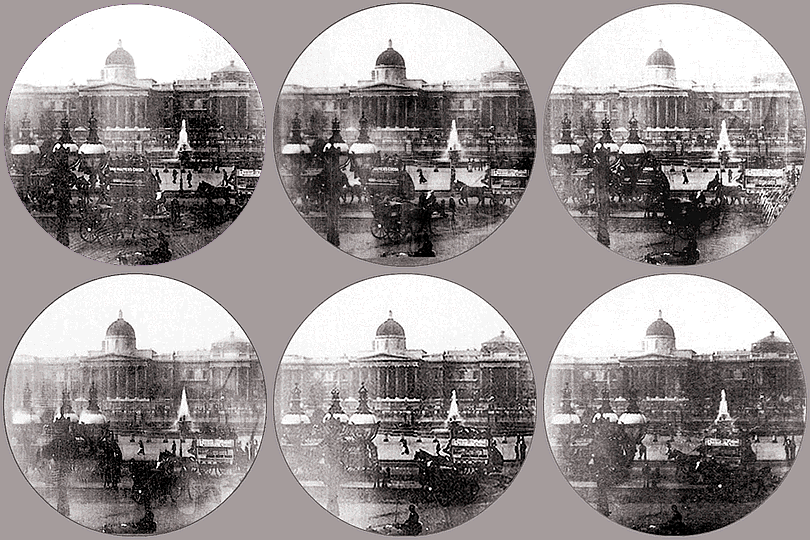
1890: London’s Trafalgar Square
There seems to be some conflicting things with this and Hyde Park Corner’s Wikipedia page as this film also is supposedly claim to be the first
film to be shot in London. Perhaps it’s because of Hyde Park Corner’s debated timeframe. Either way, it’s a 10 frame shot with a rate of 10
frames per second.
The people who shot this film were Wordsworth Donisthorpe (who wore many hats in addition to this, including being a barrister and an individual
anarchist) and William Carr Crofts (who was also an architect). The film was shot on their patented kinesigraph camera which had a circular
frame and shot on celluloid. This film was not shown publicly.
1891: Dickson Greeting
This little film was directed, produced by and starred the titular man, William K. L. Dickson. It’s a 3-second clip of him passing a hat
between his hands in front of himself. It was produced in New Jersey via Edison Labs, using a kinetograph camera. The film was done on
May 20th, 1891, and days later it was shown to a group of 147 women at the National Federation of Women's Clubs.
There is something cute and charming about this little piece of film. Though it’s only 3 seconds long and you don’t even see William complete
his movement, there’s something cute about it.
1892: Pauvre Pierrot
An animated film! Apparently, this film was originally around 14 minutes long, but the restoration makes it in the 4-minute area
(nearly 5 with titles and such). The artistry in this is really charming– from the look of the characters to how it’s animated. It took 500
individually painted frames to make this work, which is quite astounding!
This one has more of a plot than any previous discussed. The characters are taken from Italian theater tropes– Harlequin, Columbia and
Pierrot. Harlequin sneaks into Columbia’s courtyard to see her. Their rendezvous is interrupted by Pierrot, who comes knocking in an
attempt to woo Columbia. He tries to serenade her, but is interrupted by Harlequin and eventually scared away. Pierrot retreats into the house
in the final frames of the film.
The story is simple but it’s done in a very charming way that it made it a fun watch.
The man behind this was Charles-Émile Reynaud. He’s quite another interesting rabbit hole of a human; Aside from being the first person to create
an animated film, he worked on steam engines at the age of 13, studied a variety of things including Greek, Latin and various branches of sciences,
was the assistant to a priest and was even a nurse during the Franco-Prussian war.
He first worked with a magic lantern, a device akin to an early projector. He went on to create the praxinoscope, successor to the zoetrope,
both early ways to make animation. After that, he made the Théâtre Optique, another film system and the one that Pauvre Pierrot utilized!
Alongside this landmark, Pauvre Pierrot is also the first film that utilized using film perforations.
Charles-Émile Reynaud had other films; In fact, the original entry for this was another one of his, Le Clown et ses Chiens. However, a lot
of his work is lost to time. Charles-Émile Reynaud ended up destroying his Théâtre Optique with a hammer and throwing 5/7 of his films into
the Seine river around 1913.
1893: Blacksmith Scene
Blacksmith Scene is pretty much what it says on the tin: a scene of men doing blacksmithing. The film clocks in at around 30 seconds
(40 if you include titlecard) and then just shows 3 men hitting metal, all taking a swig of what I’m guessing is beer, and then hitting metal
some more.
The film was shot in New Jersey by William K.L. Dickson and William Heise, for the Edison Company.
Now, something did bother me about this film. While reading the Wikipedia article on it I noticed something: 2 actors are listed, but there are
3 men in the film. What gives? Two of the men are Charles Kayser, acting as the Blacksmith, and John Ott, acting as one of the assistants.
It seems the third man is lost to time.
You may or may not have noticed my choice of words in the previous paragraph, namely the word, “acting”. None of these men are actual blacksmiths,
and this marked the real first use of actors in a movie. In fact, the anvil was brought in from outside as well!
The film was shown on May 9th at the Brooklyn Institute of Arts and Sciences (now known as the Brooklyn Museum). In addition to being the
first film featuring actors, it was also the first Kinetoscope film shown in a public exhibition and the first film to be copyrighted the
same year of production.
1894: Luis Martinetti, Contortionist
One thing about me is I think contortionism is very cool. I don’t understand how people can do it, but I’m always in awe seeing people
seamlessly move. The man in this movie, Luis Martinetti, performs a routine, suspended by trapeze rings. It’s cool, really cool!!!
It’s another Edison Company film, and like the former one, both made by William K.L. Dickson and William Heise. I’ve seen conflicting numbers
on how long this film runs– despite Wikipedia saying it’s 12.5 seconds, the video they have is 16. I’ve also seen people say it’s 30...? Either way,
Luis Martinetti was a contortionist and worked with his brother.
I couldn’t really find a lot about this film, but I did see a lot of people rating it low... Don’t listen to them, Luis Martinetti, I think you did
a great routine.
1895: La Mer
Back to France with the lovely La Mer! It’s another “documentary” film, showing 4 boys and a woman, assumed to be their mother, jumping into the ocean
as its waves wash forward. One of the boys actually ends up flipping into the ocean, which feels a bit insane given that it seems the water only
comes up to the mother’s midsection.
The film is shot by Louis Lumière, a man with a very appealing name. It was filmed using a cinematograph (sometimes called a kinematograph) – an all
in one camera that also worked as a projector and developer! It was also featured in the first commercial presentation of Lumière Cinématographe,
on December 28th in Paris.
1896: The House of the Devil
Now we get into trick films and Georges Méliès! The film is considered the first horror film and by some the first vampire film.
It’s the longest yet and was considered ambitious at the time clocking in at 3 minutes of footage.
The basic premise is two cavaliers walk into the titular house of the devil and have various kinds of tricks played on them via the supernatural
beings that lurk inside.
The film is endearing and it’s early usage of trick film techniques is really cool, especially when you consider how new the technology was
(though it was pioneered by Méliès himself, though Alfred Clark technically beat him to the punch in 1895– with a movie that’s also considered
a horror film by virtue of it being about beheading... Maybe it’s a matter of semantics of what people consider a film. On a similar note, this
wasn’t supposed to be horror- it was made for comedic purposes.) I really like the flying bat and the way the characters disappear and
re-appear– there’s even a little smoke, which is really cool!
Like many films of it’s era, the actors were not credited for their roles. The only concrete actor we know of is Jehanne d'Alcy, who was
Méliès’ mistress and later his 2nd wife, alongside being a stage actress. People have hypothesized Jules-Eugène Legris to have a role in the
film too, and it’s highly possible due to his involvement in a later Méliès film. The sets for the movie were hand-painted and filmed outdoors.
There is one thing that eludes me and that escape bugs me: The history of the film in the public sphere. What’s available online is the
following information: The only known copy of the film was found sometime between 1930-1949 in New Zealand, but it was not brought to light
on what it was until 1985.
For me, this brings up more questions than answers: How long was it missing for? When was it last shown? How the hell did it end up over
11,915 miles away in New Zealand of all places? And in a junk shop no less? Méliès died in Paris in 1937– However, he had a brother named
Gaston who made a few films in New Zealand around 1912-1913 (notably the lost Hinemoa in 1913!)... Could it be related to his time there?
What would Gaston be doing with his brother’s film? It’s not like Gaston was there for long– he moved back to France in 1913 and died in 1915.
Who bought it? Did they screen it themselves, not knowing? What piqued their interest anyway– were they a connoisseur? Someone who just liked
collecting various things? Was the finder also the person who brought it to a film archivist? What was the process of confirming it?
There’s no real answer to any of these I was able to find (except perhaps a guess, but that’s hardly a real answer.) While people will call
this the first horror film, I instead will be awake at night questioning it’s journey through time.
1897: The Bewitched Inn
Another Georges Méliès, completely accidentally and on account of it’s cool name! This is yet another one of his iconic trick films and
another with a horror twist. It’s shorter than the previous one, clocking in at 2 minutes.
The premise of this one is a traveler goes to an inn and inside of his room, he has an unseen force play various tricks on him, from making
his belongings disappear to making things move around the room. There’s something kind of funny about the film being this guy who’s just annoyed
at stuff moving rather than scared and only giving up on sleeping in the room when everything just appears on the bed. In my head, I hope he
just goes up to the front desk to complain but ends up settling back in the room to more shenanigans... It feels like it’d be fitting for the
rest of this movie.
There is one actor in the film and its Mr. Méliès himself! It’s cute in a way and maybe that’s part of a big charm is he went all out for
his own film... His acting is very endearing in my opinion. The sequences of animated objects were done using wire (aided by perspective of the
camera to cover the operators) and substitution splicing (also known as stop-trick, in which an item is removed between shots). The film was
also shot outdoors.
This movie is reminiscent of an earlier Méliès film from a year prior (A Terrible Night– in which a man has trouble sleeping as a giant bug
crawls around). Apparently this was a popular thing already on stage and Méliès had just transferred it to film.
It is said by John Frazer in his book on Méliès, Artificially Arranged Scenes: The Films of Georges Méliès (1979), that it was likely Méliès
was inspired by a stageplay called The Devil’s Pills (originally performed 1839) that included a haunted room. Alongside this, Frazer states
he may have also been inspired by a routine by acrobatics the Hanon-Lees’ routine, The Journey to Switzerland, in which a pair of boots walk
up a wall and vanish.
All in all, it’s a very cute film and quite endearing.
1898: Early Fashions on Brighton Pier
The film is endearing in the fact it’s a cute snapshot of humans. The film, clocking in at a minute long, is just a shot of people walking on
Brighton Pier in England. In it you can see people walking by looking at the operator, some waving, some tipping their hats, some unruly children,
even a man being hoisted by 2 others happily to show off to the camera. There’s something incredibly beautiful about it in it’s simplicity of
capturing a place and time in humanity. The people in this film have all long passed, even the youngest members in the crowd, but it’s a lovely
recollection that they were there in the first place and that across time and space, people are the same in very cute ways. As the people stare
back into the camera, being immortalized by it, you can’t help but wonder about the small details of their lives– in that moment, before it,
after it... And think about humanity’s place in the world as a whole.
On a more technical side: The film is also interesting in the fact there’s been debate over attribution of who the filmmaker is. The original
attribution was of George Albert Smith, an Englishman who wore many hats including inventor, psychic, hypnotist, and lecturer among a few other
titles. However, in the crowd, children of James A. Williamson– a Scottish filmmaker (and associate of Smith)-- are spotted, leading historians
to be more inclined to think it was Williamson at the helm of this film.
In a similar note, the film has also been called On The South Pier by The University of Brighton’s Screen Archive South East– an archive for
films for the South East of England.
1899: The Devil in a Convent
I’m sorry filmmakers from all over, I swear I’m not going out of my way to watch films from Georges Méliès– he just has the most interesting titles!
This film is similar to The House of The Devil in themes of the devil appearing, but it’s much more of a religious affair, especially as it’s
set in a convent. The devil appears and causes all kinds of various trickery and mischief before being ousted by Saint Micheal.
This film really is another one that just builds on the artistry of the sets used by Méliès and is probably my favorite yet with regard to that.
It also has a lot more moving parts and people, adding to the visual spectacle of it.
As like with The Bewitched Inn, Méliès takes center stage, this time as the devil. I can’t find any record of who the numerous other actors are
in this film. In addition, this film is stated to be the first Méliès film where he utilizes dissolution as a visual technique. Alongside this,
the film employs his stop-trick alongside of what appears to be usage of trap doors with some sort of rig that allows the performers to move up
and down on a platform beneath the “stage”. It’s said that inspiration from this film was drawn from magician Étienne-Gaspard Robert, alongside of
being a result of Méliès’ thoughts on the Dreyfus Affair.
The Dreyfus Affair concerned the wrongful imprisonment and conviction of 35-year-old Captain Alfred Dreyfus. He was accused of treason and
spreading French military secrets to the German Embassy in Paris in 1894 and sentenced to live in harsh conditions in a penal colony in French
Guiana, carried out for the next 5 years. It’s said Méliès already had a typical anticlerical opinion of the time, though his was more poking fun
at it. However, he has been cited as being pro-Dreyfus and took issue with the church’s stance against Dreyfus. Despite this, Jehanne d'Alcy,
Méliès’ second wife, said he was not actually anti-clerical and in general he has been noted to only care about such affairs for his theatric
spectacles.
While the movie was never lost, in 2010, the Cinémathèque Basque received a collection of 35mm films, recovered by a private collector from the
trash. Among the 32 films, a hand-colored rendition of The Devil in a Convent (alongside another Méliès film from 1899, The Mysterious Knight.)
However, the bulk of The Devil in a Convent was too decayed to be properly restored, except for the third act. The two films were entrusted to the
film archive, Filmoteca de Catalunya, in Spain, for restoration and put under the care of two Méliès scholars.
Review
In the prologue, I stated I would not be rating these films– However, I think it’s still fun to put them in a little list on personal enjoyment! Without further ado, here is my list and my reasonings:
1.Passage de Vénus (1874) – While the film quality may not be great, what it represents is quite amazing. The international cooperation for this amazing scientific event is quite stunning, especially when considering the time.
2. The Horse in Motion (1878) – Similar to Passage de Vénus, I believe the historical value is so stunning that it deserves second place. This small piece of film changed how artists viewed the world of drawing horses– that’s crazy!!
3. The Devil in a Convent (1899) – This one is for artistry’s sake. The imagery used in the film is really so cool and interesting to look at. It’s also fun to see Méliès’ acting alongside of his work actually making the movie. Really fun!!
4. Early Fashions on Brighton Pier (1898) – It’s a tossup between this and the next, but the humanity side of it is just so beautiful to me. It’s a really cool snippet of history and the human experience despite it being just a minute capture of people’s day-to-day life.
5. The Bewitched Inn (1897) – I just think this is charming, both as a concept and with the acting. Very fun and endearing.
6. Pauvre Pierrot (1892) – The artistry in this is very charming and cute. The fact there are so many individually made frames and that so many survive is quite amazing. I wish there was more of it...
7. La Mer (1985) – Another one that’s just endearing because of how simple it is. Incredibly adorable how this family’s fun day was captured and survives to this day.
8. Roundhay Garden Scene (1888) – Similar to La Mer, but the peacefulness of it is quite cool. The fact it also immortalized a woman who died not even 2 weeks after this is filmed is moving in a profound way.
9. House of The Devil (1896) – Very endearing, but I think it doesn’t transfer as well as the other 2 movies on this list by Méliès’.
10. Luis Martinetti, Contortionist (1894) – It’s just cool... How people could rate it low is a shame...
11. Dickson Greeting (1891) – Cute : )
12. London’s Trafalgar Square (1890) – A cool snippet of time and place, and a cool snippet of older carrages!
13. Blacksmith Scene (1893) – Tag THREE blokes who do fuck all... Interesting that it’s the first real use of actors!
14. Man Walking Around A Corner (1887) – Really what it says on the tin, isn’t it? No complaints!
15. Monkeyshines (1889) – NO Monkeys shown!! Also just kind of a let down when you watch what came before it.
16. Leisurely Pedestrians, Open Topped Buses and Hansom Cabs with Trotting Horses (1889) – Imagine being underwhelming to an audience who this was all new for that sucks